Disclaimer
These descriptions are NOT intended as instruction. No pilot should attempt to fly any of these figures in aircraft not certified for aerobatic flight. Further, no pilot should attempt these figures without training from a competent aerobatic instructor.
Below is a list of aerobatic figures and the symbols used to represent them. Each figure starts at the small solid circle and ends at the vertical bar. All aerobatic figures start and end from horizontal lines in either upright or inverted flight. Solid lines describe upright flight, and dashed lines describe inverted flight.
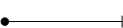
Normal Flight
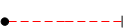
Inverted Flight
The elements used in these figures are horizontal, vertical and 45° lines. These describe straight flight in these directions. Parts of loops connect these line segments. Rolls in 1/4, 1/2, 3/4, etc. increments up to 2 rotations can be added to the lines.
The looping portions in almost all figures have to have the same radius in all parts of a figure. For instance the quarter loops going into and coming out of a hammerhead have to have the same radius. There are some figures where this does not apply completely.
Rolls on vertical lines and on 45° lines have to be centered on this line to score well. Any deviation from the center results in a downgrading during a competition.
The K-values included with the competition figures give an indication of the difficulty of each of these maneuvers. Higher K-values mean more difficult maneuvers. Each figure is assigned a score from 0 to 10, which is then multiplied by the K factor.
Rolls
There are four basic types of rolls: Aileron Roll, Barrel Roll, Slow Roll, and Snap Roll. The aileron and barrel rolls are not flown in aerobatic competitions.
Aileron Rolls
Aileron rolls are flown with the rudder and elevator in the neutral position during the roll. The aileron is fully deflected in the direction of the roll. This is the easiest of the rolls to fly.
The aileron roll is started by pulling the nose up to 20 - 30 degrees above the horizon. The elevator is then neutralized and the aileron fully deflected in the direction of the roll. The controls are maintained in that position till the
Barrel Rolls
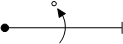
The Barrel roll is a combination between a loop and a roll. You complete one loop while completing one roll at the same time. The flight path during a barrel roll has the shape of a horizontal cork screw. Imagine a big barrel, with the airplanes wheels rolling along the inside of the barrel in a cork screw path. During a barrel roll, the pilot always experiences positive Gs. The maximum is about 2.5 to 3 G. The minimum about 0.5 G.
Slow Rolls
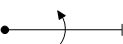
Slow rolls are flown normally on a straight line (one exception is rolls flown at the top of a loop). The roll rate has to be constant and the flight path must continue in a straight line. This requires constantly changing rudder and elevator control inputs throughout the roll. Hesitation or point rolls include stops at certain roll angles. Two-, four-, and eight-point rolls are allowed. A notation such as 2x4 denotes two points of a four-point roll. A number by itself (2, 4, or 8) means a full 360º roll with the specified number of hesitations. If no points are specified, rolling is done without hesitations. A roll symbol that starts at the line denotes a half roll (see description of the Immelman). A roll symbol that crosses the line specifies a full roll (first figure).